

A CERT (European Organization for Certification) is a specialized certification body dedicated to establishing transparency, trust, and quality assurance across agricultural value chains. Within the Crop-MATCHING project, A CERT plays a pivotal role in empowering small-scale farmers to demonstrate the authentic value of their farming practices.
1. Key Contributions of A CERT in Crop-MATCHING
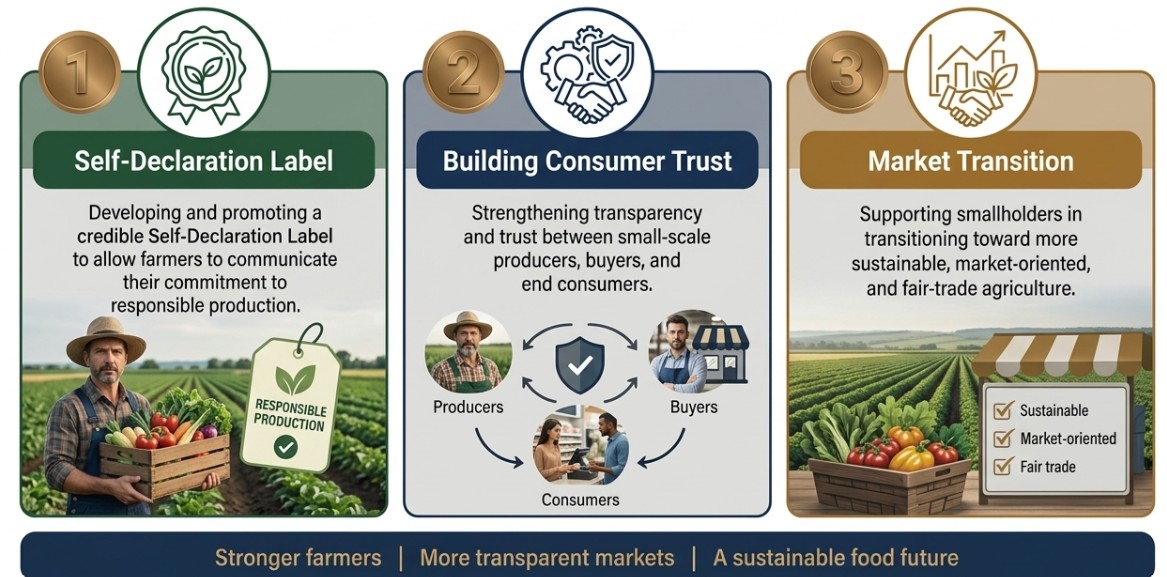
A CERT’s key contribution to Crop-MATCHING lies in developing and promoting a credible Self-Declaration Label that enables small-scale farmers to communicate their commitment to responsible production and sustainable agricultural practices. By enhancing transparency and providing reliable information about farming practices and product characteristics, A CERT aims to strengthen trust among small-scale producers, buyers, and end consumers. Furthermore, it supports smallholders in their transition towards more sustainable, market-oriented, and fair-trade agriculture, helping them improve their competitiveness, access market opportunities, and establish more transparent and equitable relationships across the agri-food value chain.
2. The Challenge for Small-Scale Farmers
For smallholder farmers, adopting sustainable cultivation is only part of the journey. Demonstrating how products are grown, fulfilling strict buyer requirements, and accessing reliable commercial channels are equally crucial. However, conventional certification schemes and heavy documentation requirements frequently impose prohibitive financial and administrative burdens on smaller agricultural enterprises.
3. Proposed Solution
Under the Crop-MATCHING project, a voluntary self-assessment and assurance framework is being explored: the Crop-MATCHING Farm-to-Market Assurance Framework (CMAF). CMAF equips farmers with practical tools to organize essential production data, evaluate their farming practices, and turn this information into clear, market-ready product presentations.
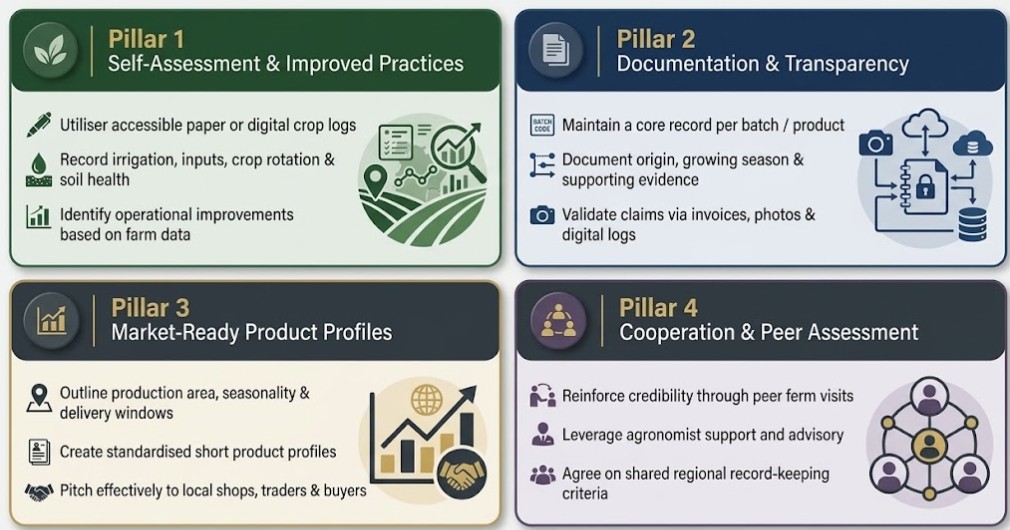
The CMAF framework is built around four complementary pillars designed to strengthen farm management, improve transparency, and enhance market access for farmers.
The first pillar, Self-Assessment and Improved Practices, encourages farmers to use accessible paper-based or digital crop logs to record irrigation, agricultural inputs, crop rotation, and soil health, enabling them to identify opportunities for operational improvement based on farm data.
The second pillar, Documentation and Transparency, promotes the maintenance of reliable records for each batch or product, documenting its origin, growing season, and supporting evidence, such as invoices, photographs, and digital logs, to substantiate relevant claims.
The third pillar, Market-Ready Product Profiles, focuses on developing concise, standardised product profiles that communicate production areas, seasonality, expected harvest and delivery windows, and verified farming practices, helping farmers engage more effectively with local shops, restaurants, traders, and consumer groups.
Finally, the fourth pillar, Cooperation and Peer Assessment, strengthens credibility and collective learning through peer farm visits, agronomist support, and agreements among local producer groups on shared record-keeping criteria tailored to regional crops.
Together, these four pillars provide a practical and accessible framework for improving farming practices, strengthening the reliability of product information, and creating stronger connections between farmers and local markets.
4. Turning Documentation into Real Market Opportunities
The true value of CMAF lies in bridging two critical needs: farm management enhancement and market access. Collected data serves not merely as administrative record-keeping, but as a strategic tool for production planning, buyer engagement, and long-term commercial relationships.
Important Note: CMAF does not replace mandatory regulatory certifications, food safety controls, or legal standards. Instead, it serves as an accessible steppingstone for self-assessment, documentation, and commercial readiness.
5. An Opportunity for Sustainable and Resilient Farms
Supporting smallholder farmers requires holistic solutions balancing agronomic realities with commercial market demands. Through collaboration, knowledge exchange, and structured assurance, Crop-MATCHING and A CERT enable small-scale farmers to demonstrate the authentic value of their work and secure their rightful place in the modern marketplace.

Horizon Europe Research and Innovation Programme
Grant Agreement No. 101182980
Views and opinions expressed are those of the author(s) only and do not necessarily reflect those of the European Union or the European Research Executive Agency. Neither can be held responsible.