

From Farmers’ Fields to Allotment Plots: Can Cover Crops Work for Hobby Gardeners Too?
Newcastle University researchers bring Crop-MATCHING expertise to a citizen science experiment
For many farmers and professional growers, cover crops are an increasingly important tool for protecting and improving soils. Crops such as phacelia, buckwheat, mustards and clovers are routinely grown between cash crops to protect and improve the soil. Their ability to reduce nutrient losses, suppress weeds, support soil biology, and improve soil structure have made cover crops an important crop matching practice.
But what happens when these practices move from a commercial farm to a much smaller allotment or garden?
Researchers at Newcastle University are exploring this question through a new citizen science experiment, launching in August 2026, which investigates how autumn sown cover crops perform in gardens and allotments.
The experiment forms part of the Hort2thefuture project and builds on Newcastle University’s involvement in Crop-MATCHING, where the team is contributing expertise in sustainable cropping, farmer and grower engagement, co-creation, training and changing social norms around sustainable practices.
From commercial cropping to gardens and allotments
Allotment holders and gardeners in the UK typically leave their fruit and vegetable plots bare over the winter, often believing it is better to let their soil rest. However, this leaves their plots vulnerable to nutrient losses, as well as wind and soil erosion.
The Newcastle University team is focusing on two cover crop options that are particularly well suited to amateur gardeners: phacelia and a buckwheat and purple vetch mix. Both options are quick to germinate and unlike some traditional green manures, that may require cultivation or mowing to terminate, phacelia and buckwheat are killed by winter frosts.
A Citizen Science Opportunity
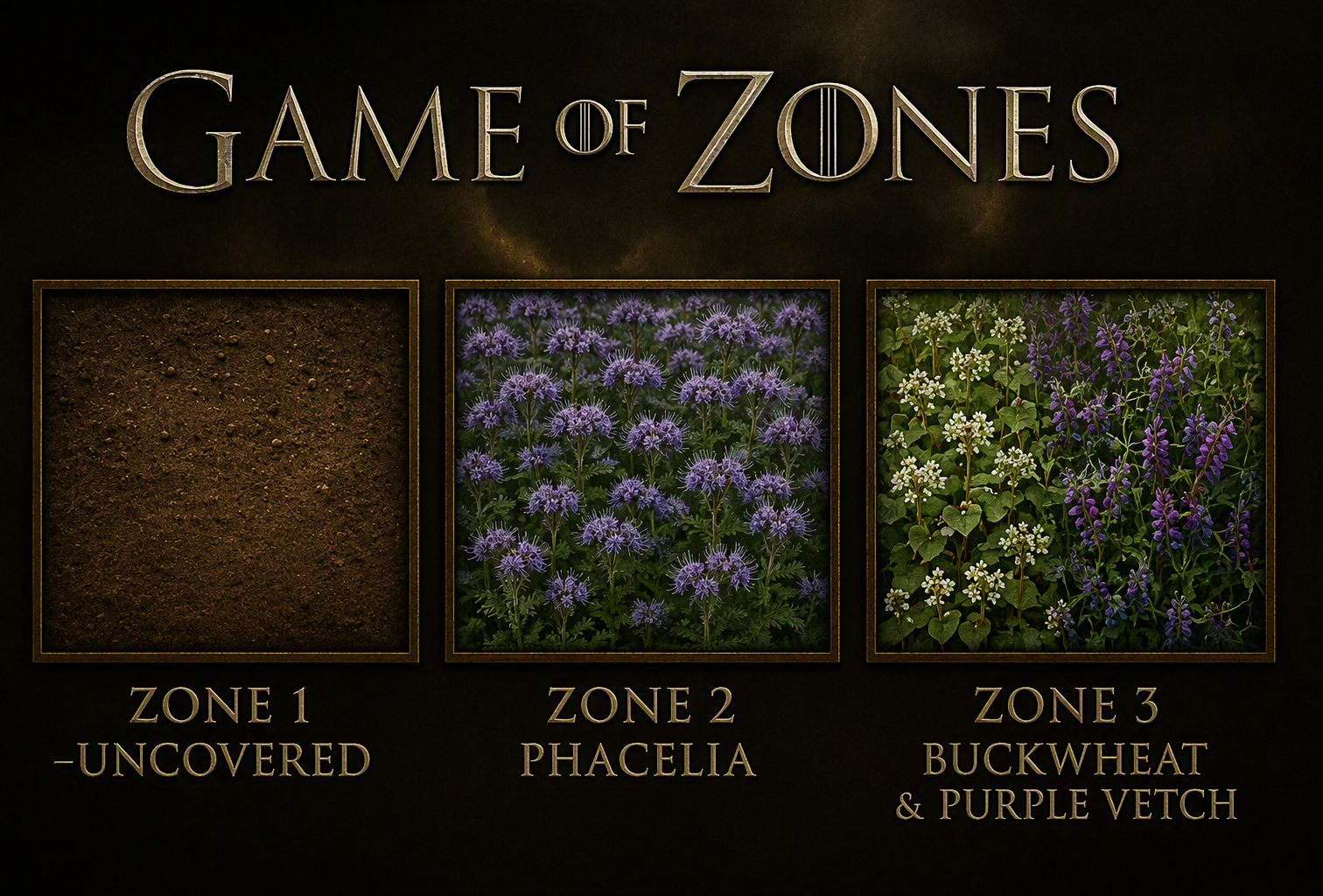
The research team is inviting allotment holders and gardeners to become part of the citizen science experiment trialling the cover crops. The experiment is straightforward: participants sow phacelia or the buckwheat and purple vetch mix on one part of a plot while leaving the other half uncovered. During the following growing season, they can compare the two areas and assess soil structure, earthworm activity, ease of cultivation, and crop performance.
The citizen science experiment has been designed according to the COM-B framework, to aid uptake by allotment holders and gardeners. Participants receive free cover crop seeds, dedicated advice and support, learn about their soil and can be come part of the experiment’s community. The experiment has a “A Game of Zones” theme where gardeners are encouraged to protect their soils as winter is coming. Professor Steve Quarrie has led the design of the citizen science experiment in collaboration with Newcastle University’s Crop Matching research team, Anton Rosenfeld at Garden Organic and the Enrich the Earth coalition.
By involving growers directly in the research, the project aims to generate practical evidence from a diverse range of gardens and allotments. The results will help understand whether a crop matching practice already familiar to farmers can deliver similar benefits for amateur growers.
More broadly, the experiment will contribute to Crop-MATCHING’s work on understanding how sustainable cropping practices can move from research evidence into everyday practice.
For further information on the citizen science cover crops experiment please contact: matthew.gorton@newcastleac.uk or Steve.Quarrie@newcastle.ac.uk

Horizon Europe Research and Innovation Programme
Grant Agreement No. 101182980
Views and opinions expressed are those of the author(s) only and do not necessarily reflect those of the European Union or the European Research Executive Agency. Neither can be held responsible.