

The role of the “Three Sisters” in sustainable farming systems
The ‘Three Sisters’ is an ancestral farming technique, initially used in the Americas by indigenous communities. It consists of a set of companion plants, species that, when grown together, mutually benefit one another in various ways. This practice, based on both traditional knowledge and scientific research, is an important technique in organic and regenerative farming. Companion plants work in harmony to create a balanced and sustainable ecosystem, resulting in healthier and more productive farming systems1.
Composed by the joint cultivation of maize (corn, Zea mays), bean (Phaseolus ssp.) and squash (Cucurbita ssp.) (Figure 1 and Figure 2), the ‘Three Sisters’ system represents a pre-colonial epistemology with scientific relevance to the history of human existence. When cultivated together, these crops can maximize overall yield, while enriching the soil. Additionally, they provide an excellent nutritional choice for the human diet2. Due to these characteristics, it is advised to plant the maize first; when it is about 15 cm height, beans are planted, followed by squash (1,2).
The benefits of this traditional Native American combination arise from its synergistic interactions:
- (i) maize provides support for the climbing beans, since it grows upwards, trying to catch as much light as possible, providing a stable structure on which the beans can climb.
- (ii) beans fix atmospheric nitrogen through symbiotic bacteria in their root nodules, enriching the soil with an essential element for the healthy growth of diverse plants, including maize.
- (iii) pumpkin/squash covers and protects the soil and shallow roots from direct sunlight, suppressing weeds and conserving moisture, its dense canopy minimizes evaporation, acting as a natural mulch protecting the soil’s surface.
The distinct root architectures of the three cultures, deep roots in maize, nitrogen-fixing roots in beans, and shallow roots in squash, improves water infiltration and storage in soil profiles (Figure 3). Due to differences in architecture, root depth, and water demand, the “Three Sisters” system resists drought, heavy rain, and frost more effectively. In practice, this results in higher yields and profitability (lower fertilization costs), improved soil health, and greater biological resilience of the entire system (3).
Although this system has been used for at least 5,000 years in what is now the north-eastern United States and southern Canada, it has now been gradually refined through observation of the relationships among the species. Nowadays, this ancient system keeps inspiring modern agriculture; while in the traditional system each plant has its own specific function, in modern agriculture, a fourth “sister” has been introduced for a multifunctional role in the ecosystem. Common sunflower (Helianthus annuus) can be added to attract pollinating insects, provide additional support for bean growth, and offer protection from wind and moisture loss for shorter plants (3).
Although this system is mainly used in the Americas, it has also been adopted in Europe through knowledge exchange on sustainable farming practices, including agroecology and diversified horticulture. In the European context, its value lies less in the exact replication of the original system and more in its conceptual relevance to intercropping practices aimed at improving resource efficiency, enhancing functional biodiversity and increasing the resilience of small-scale farming systems.
- A Cientista Agrícola (2024). 20 Plantas companheiras para a horta: o que plantar junto. https://acientistaagricola.pt/2024/06/05/20-plantas-companheiras-para-a-horta-o-que-plantar-junto/
- Seeds and Tales (2025). Três Irmãs. https://www.seedsandtales.com/pt/post/tr%C3%AAs-irm%C3%A3s
- OneWater (2025). Three Sisters of the 21st Century: How Ancient Methods Are Transforming Modern Agriculture. https://onewater.blue/article/three-sisters-of-the-st-century-how-ancient-methods-are-transforming-modern-agriculture-97fe299c
-
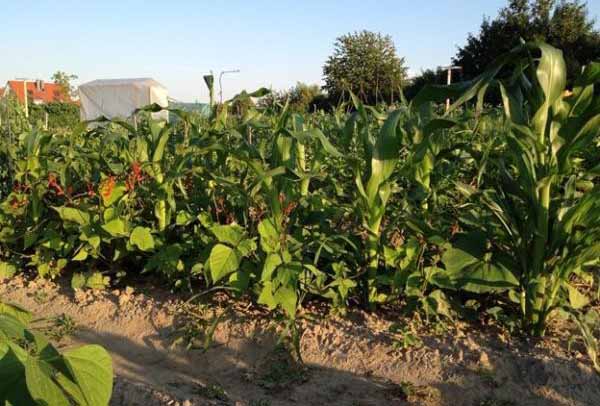
- Figure 1. Image by Joachim Quandt (CC BY-SA 2.0), via USDA (2021)
-
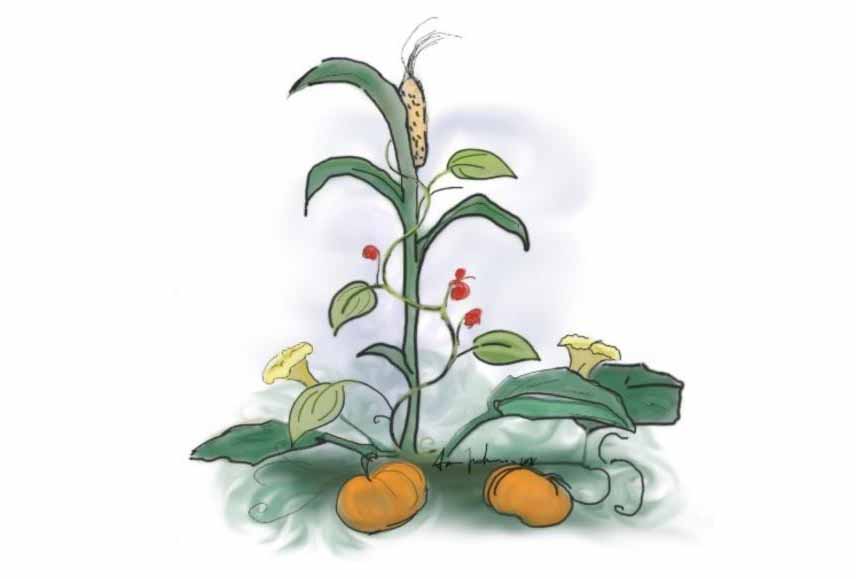
- Figure 2. Image by Anna Juchnowicz (CC BY-SA 4.0), via USDA (2021)
-
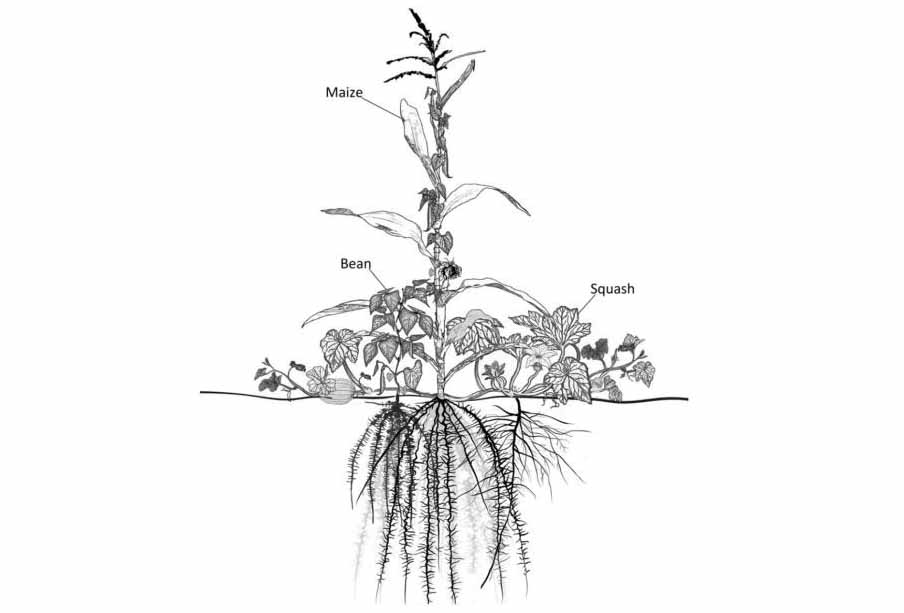
- Figure 3. Image from Lopez-Ridaura et al. (2021) (CC BY 4.0)

Horizon Europe Research and Innovation Programme
Grant Agreement No. 101182980
Views and opinions expressed are those of the author(s) only and do not necessarily reflect those of the European Union or the European Research Executive Agency. Neither can be held responsible.